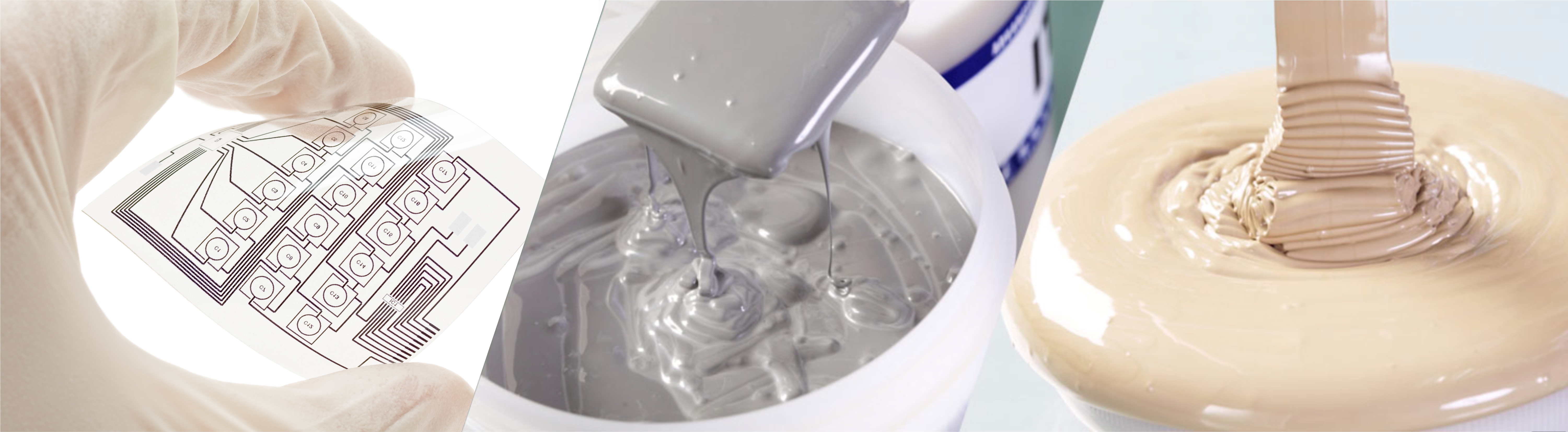
Some of our major applictions include:
Membrane switch
A membrane switch is an electrical switch for turning a circuit on and off. It differs from a mechanical switch, which is usually made of copper and plastic parts: a membrane switch is a circuit printed on PET film or ITO film.
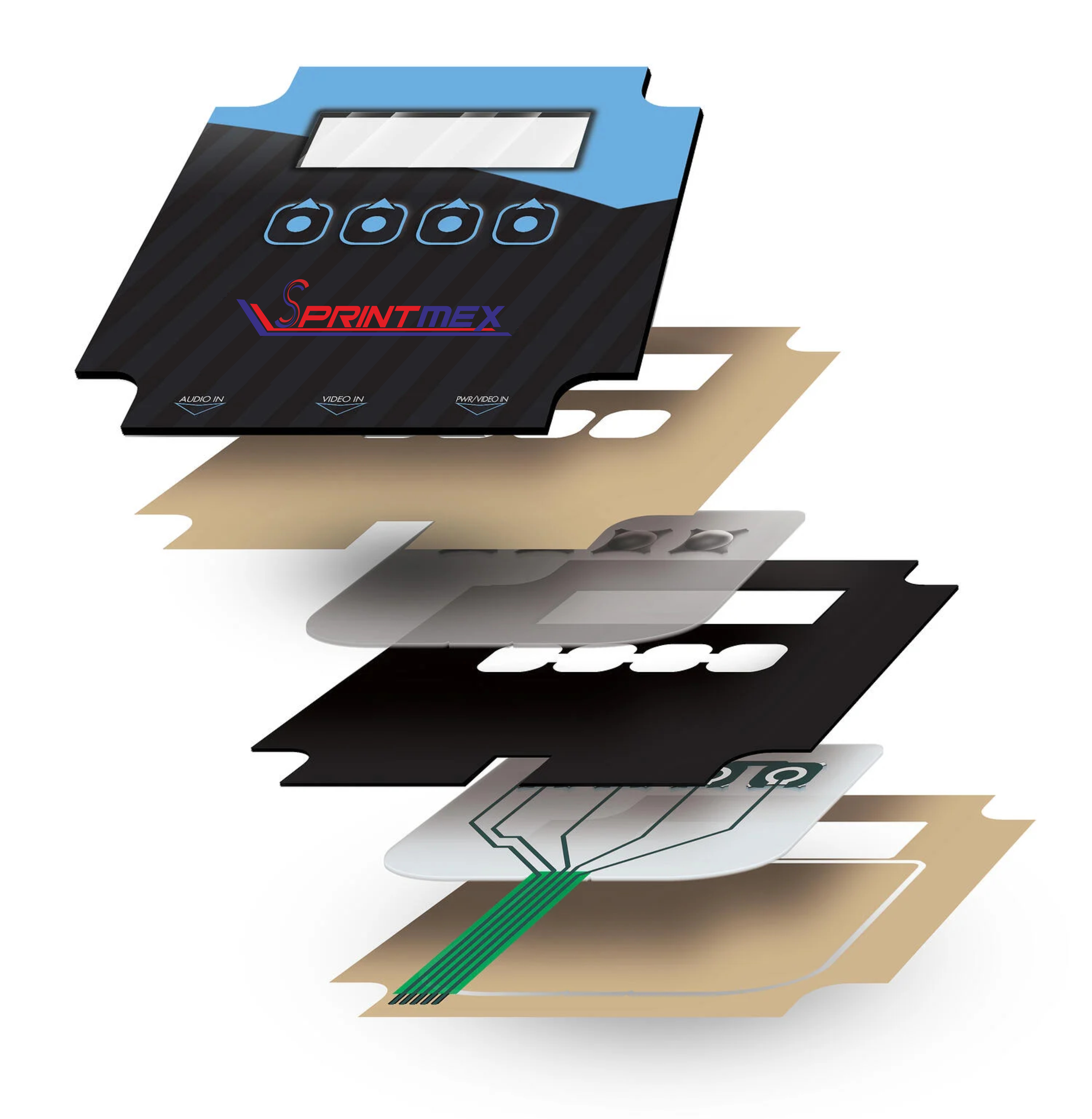
How Are Membrane Switches Constructed?
Membrane switches are essentially a sandwich of thin layers that are bonded together using pressure sensitive adhesives. Depending on the application requirements, a membrane switch will consist of as few as 4, and as many as 9 layers. In contrast to mechanical switches, membrane switches offer the advantage of lower cost, they consume less design space with their low profile, are easy to clean, and they offer a sleeker, ergonomic, and aesthetically pleasing appearance.
The visible top layer of a membrane switch is the graphic overlay, with printed circuitry underneath the overlay. T Activation of a switch occurs when a printed shorting pad or metal dome makes contact with the bottom circuit layer thus, closing the circuit.
Sprintmex supplies silver conductive inks , carbon inks , UV/IR curable dielectrics, screen printable PSA, spacer inks, crimping pins , housings for membrane switch applications.
Membrane switches are essentially a sandwich of thin layers that are bonded together using pressure sensitive adhesives. Depending on the application requirements, a membrane switch will consist of as few as 4, and as many as 9 layers. In contrast to mechanical switches, membrane switches offer the advantage of lower cost, they consume less design space with their low profile, are easy to clean, and they offer a sleeker, ergonomic, and aesthetically pleasing appearance.
The visible top layer of a membrane switch is the graphic overlay, with printed circuitry underneath the overlay. T Activation of a switch occurs when a printed shorting pad or metal dome makes contact with the bottom circuit layer thus, closing the circuit.
Sprintmex supplies silver conductive inks , carbon inks , UV/IR curable dielectrics, screen printable PSA, spacer inks, crimping pins , housings for membrane switch applications.
Electroluminscent lamps
Electroluminescent lamps are made by screen printing and Sprintmex provides the know-how, the complete set of raw materials for the same.
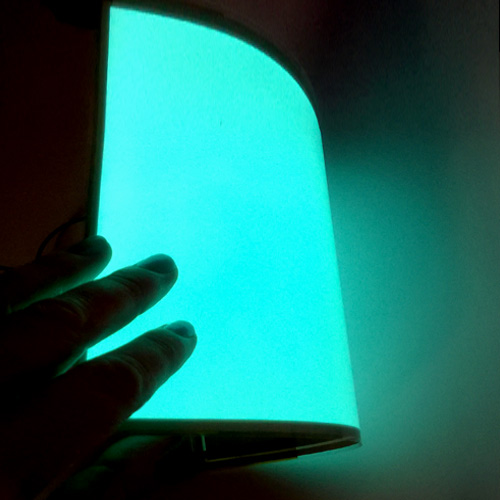
The advantages EL technology has :
- Thin, soft and flexible from 0.08mm to 0.5mm (photo if possible)
- Cool and non-glare lighting, has good visibility in FOG
- High resolution
- Luminosity is independent against temperature
- Has 160 degree of broad eyesight
- Uniform surface illumination
- Vibration and impact resistance
- Low power consumption (actual power consumption less than Led)
- Colourful, animated
- Cut with any shape available
EL lamps is an excellent choice for backlighting for industrial and commercial applications as well as in POP Signage posters, tshirts, caps.
Sprintmex EL starter kit is ideal for customers attempting to make EL lamps for the first time.

- Thin, soft and flexible from 0.08mm to 0.5mm (photo if possible)
- Cool and non-glare lighting, has good visibility in FOG
- High resolution
- Luminosity is independent against temperature
- Has 160 degree of broad eyesight
- Uniform surface illumination
- Vibration and impact resistance
- Low power consumption (actual power consumption less than Led)
- Colourful, animated
- Cut with any shape available
EL lamps is an excellent choice for backlighting for industrial and commercial applications as well as in POP Signage posters, tshirts, caps.
Sprintmex EL starter kit is ideal for customers attempting to make EL lamps for the first time.
Heating elements
Positive Temperature Coefficient (PTC) ink is a self-regulating thermally conductive printable ink that is dramatically changing the way heating applications are manufactured.
Eliminating the need to use traditional wires that can overheat, burn, melt, or cause damage, PTC ink is an exciting technology with the potential to increase safety and reliability for a wide variety of heating applications.

The advantages Heated Printer:
- Increased safety: Self-regulating PTC ink can be used to design heating elements that heat quickly to equilibrium temperature and stabilize without external controls. PTC heaters are self-regulating to a specific threshold temperature, inherently preventing failures due to overheating, burning or melting.
- Simple and lightweight.
- Silent operation.
Durable in harsh environments are corrosion and water-resistant.
- Designed to the desired temperature.
- Uniform heat.eradicating irksome “hot spots”.
- Rapid heating.
- Reduced power consumption.
- Thin and flexible.
Applications:-
- Apparel heating
- Automotive seat heaters
- Floor and Wall heating
- Mirror heaters and defoggers
- Medical Applications
Medical (Bio-Sensors)
For medical electronics products, reliability and dependability are critical.
Biosensors such as glucose test strips,EKG/ECG electrodes, TENS pads for muscle stimulation, iontophoresis pads for drug delivery and countless
other medicalelectronics applications depend on conductive inks to provide accuracy, reliability and compatibility. Formulated to be compatible with the human body and various interactive medical gels and chemicals these advanced inks are making modern medical devices possible.
Bio sensors blood glucose strips:
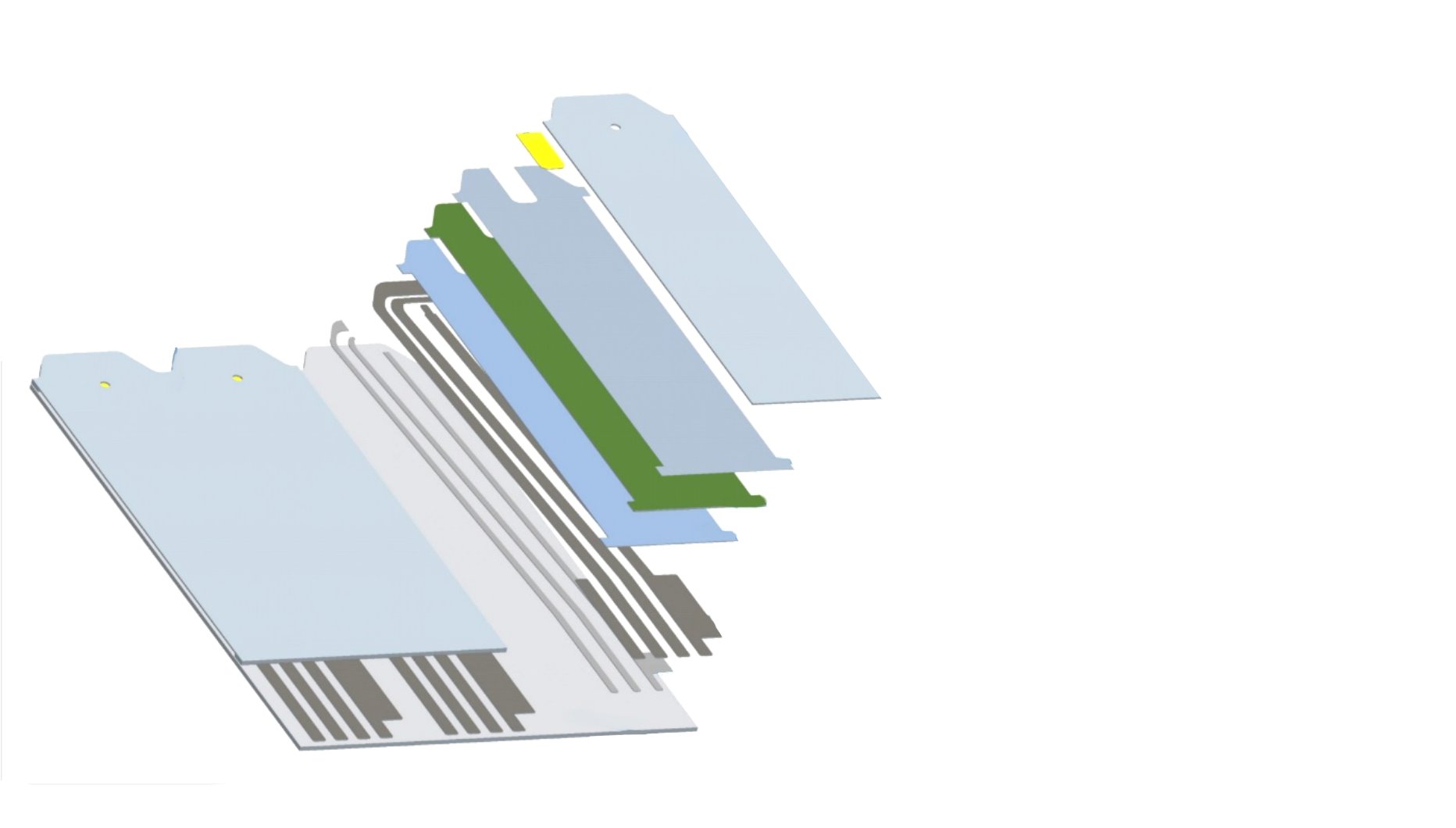
A glucose blood trip requires small amount of blood to be applied on a disposable test strip connected to a meter.
All manufacturers differ slightly but the general structure remains the same.
Detection of glucose is dependent on redox reaction with glucose oxidase
Current is produced proportional to glucose concentration.
Sprintmex can support to set up the first-generation mass production line to produce blood glucose test strips of superior and consistent quality
Touch Panels
Resistive touch panels are generally the most popular technology and divided into 4-wire, 5-wire or 8-wire resistive.
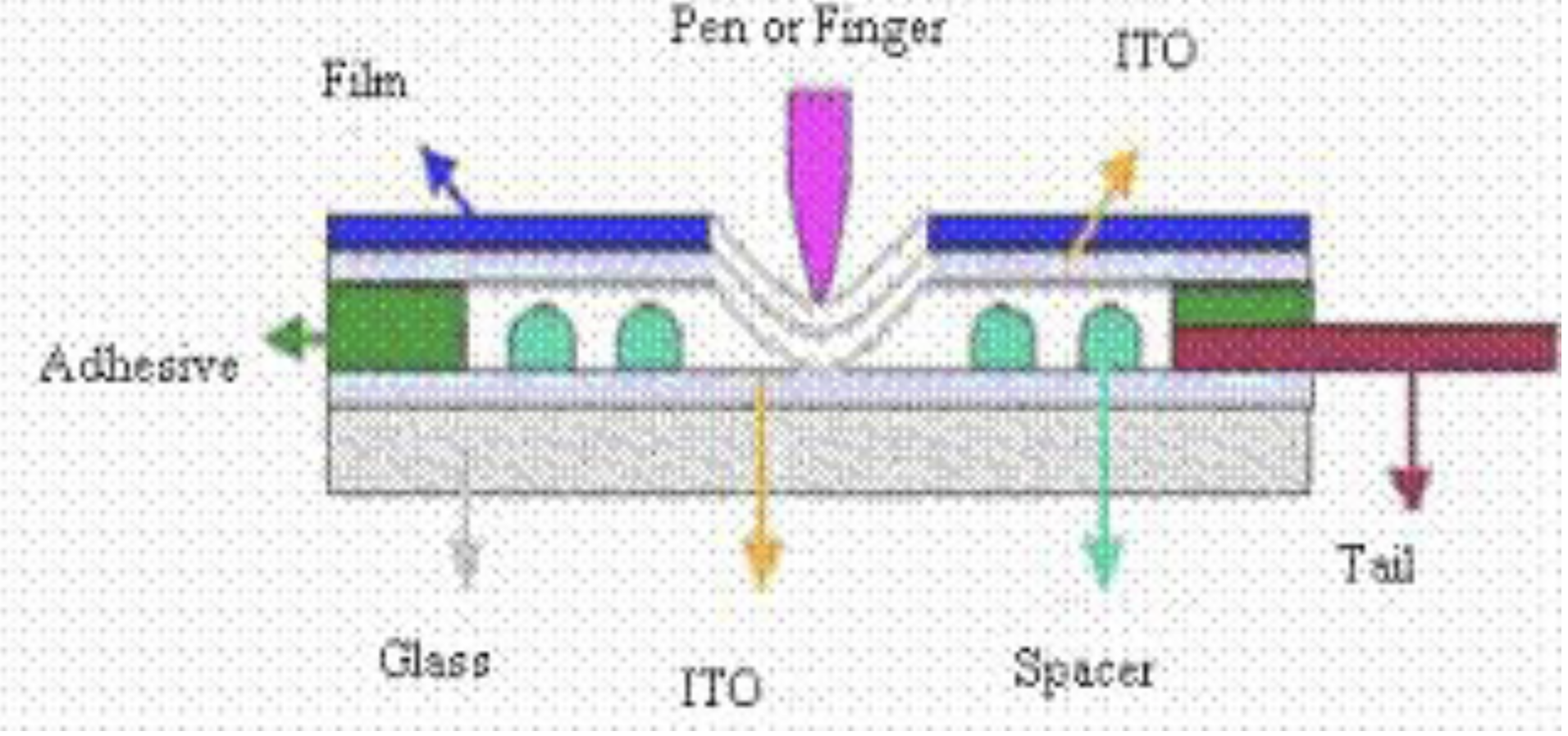
Depending on the different sensor functions, touch panel are divided into:
Resistive:Pressing the flexible top sheet creates electrical contact between the resistive layers, essentially closing a switch in the circuit. The control electronics alternate voltage between the layers to get x then y touch coordinates.
Capacitive:A bare finger or conductive stylus draws current from each corner of the electric field, creating a voltage drop that is measured to determine touch location.
Acoustic Wave:These waves are reflected across the glass and received by sensors. A finger or other soft tipped stylus absorbs some of the acoustic energy and the controller measures the amplitude change of the wave to determine touch location.
Ink Codes:
- Silver Inks: PA591; PA585
- Dielectric Inks: UP316; UP283
- Pressure sensitive adhesive : PSA 710
- Conductive adhesives paste: BS86; BS25
- Antisotropic conductive adhesive : AI176
info@sprintmex.in
Address:- 3, Ishwardas Industrial estate,Near Audi Showroom, Raghunath nagar ,Thane west Maharashtra INDIA 400604
Tel:- +91-9324089320/9930911987
- Increased safety: Self-regulating PTC ink can be used to design heating elements that heat quickly to equilibrium temperature and stabilize without external controls. PTC heaters are self-regulating to a specific threshold temperature, inherently preventing failures due to overheating, burning or melting.
- Simple and lightweight.
- Silent operation.
-
Durable in harsh environments are corrosion and water-resistant.
- Designed to the desired temperature.
- Uniform heat.eradicating irksome “hot spots”.
- Rapid heating.
- Reduced power consumption.
- Thin and flexible.
Applications:-
- Apparel heating
- Automotive seat heaters
- Floor and Wall heating
- Mirror heaters and defoggers
- Medical Applications
- Apparel heating
- Automotive seat heaters
- Floor and Wall heating
- Mirror heaters and defoggers
- Medical Applications
Medical (Bio-Sensors)
For medical electronics products, reliability and dependability are critical.
Biosensors such as glucose test strips,EKG/ECG electrodes, TENS pads for muscle stimulation, iontophoresis pads for drug delivery and countless
Bio sensors blood glucose strips:
A glucose blood trip requires small amount of blood to be applied on a disposable test strip connected to a meter.
All manufacturers differ slightly but the general structure remains the same.
Detection of glucose is dependent on redox reaction with glucose oxidase
Current is produced proportional to glucose concentration.
Sprintmex can support to set up the first-generation mass production line to produce blood glucose test strips of superior and consistent quality
A glucose blood trip requires small amount of blood to be applied on a disposable test strip connected to a meter.
All manufacturers differ slightly but the general structure remains the same.
Detection of glucose is dependent on redox reaction with glucose oxidase
Current is produced proportional to glucose concentration.
Sprintmex can support to set up the first-generation mass production line to produce blood glucose test strips of superior and consistent quality
Touch Panels
Resistive touch panels are generally the most popular technology and divided into 4-wire, 5-wire or 8-wire resistive.
Depending on the different sensor functions, touch panel are divided into:
Resistive:Pressing the flexible top sheet creates electrical contact between the resistive layers, essentially closing a switch in the circuit. The control electronics alternate voltage between the layers to get x then y touch coordinates.
Capacitive:A bare finger or conductive stylus draws current from each corner of the electric field, creating a voltage drop that is measured to determine touch location.
Acoustic Wave:These waves are reflected across the glass and received by sensors. A finger or other soft tipped stylus absorbs some of the acoustic energy and the controller measures the amplitude change of the wave to determine touch location.
Ink Codes:
- Silver Inks: PA591; PA585
- Dielectric Inks: UP316; UP283
- Pressure sensitive adhesive : PSA 710
- Conductive adhesives paste: BS86; BS25
- Antisotropic conductive adhesive : AI176
Resistive:Pressing the flexible top sheet creates electrical contact between the resistive layers, essentially closing a switch in the circuit. The control electronics alternate voltage between the layers to get x then y touch coordinates.
Capacitive:A bare finger or conductive stylus draws current from each corner of the electric field, creating a voltage drop that is measured to determine touch location.
Acoustic Wave:These waves are reflected across the glass and received by sensors. A finger or other soft tipped stylus absorbs some of the acoustic energy and the controller measures the amplitude change of the wave to determine touch location.
Ink Codes:
- Silver Inks: PA591; PA585
- Dielectric Inks: UP316; UP283
- Pressure sensitive adhesive : PSA 710
- Conductive adhesives paste: BS86; BS25
- Antisotropic conductive adhesive : AI176
- Silver Inks: PA591; PA585
- Dielectric Inks: UP316; UP283
- Pressure sensitive adhesive : PSA 710
- Conductive adhesives paste: BS86; BS25
- Antisotropic conductive adhesive : AI176
info@sprintmex.in
Address:- 3, Ishwardas Industrial estate,Near Audi Showroom, Raghunath nagar ,Thane west Maharashtra INDIA 400604
Tel:- +91-9324089320/9930911987